Tattoos fanlisting
about Tattoos
What are tattoos?
Tattoos are a form of body modification in which ink is inserted into the skin by a needle or another similar pointy tool. There are many reasons for why a person would get tattooed, from spiritual and ritualistic, to cosmetic and medical.
History of tattoos
Tattooing has been present in numerous cultures observed throughout history. At the moment the oldest known tattooed human is Ötzi the Iceman, found in the Alps. It is estimated that he lived around 3300 BCE.Tattooing practices around the world
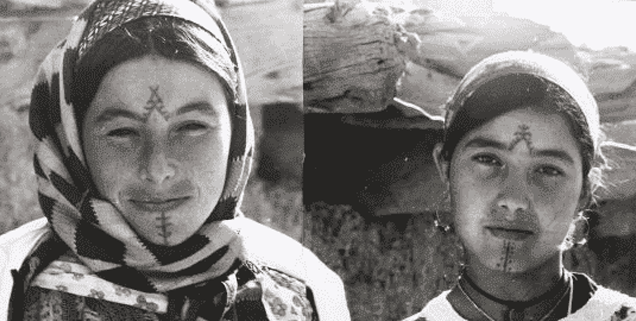
If you are wondering what the header images are, they are examples of different traditional tattooing practices! I will explain each header image in order of appearance:
- Bosnia & Herzegovina / Dalmatia, Catholic Croats - Sicanje
-
Sicanje is a dying practice that belongs to Catholic Croats that live in parts of Herzegovina and Dalmatia. Mostly women were tattooed to prevent themselves from being forcefully converted to Islam and as a way to show their heritage/faith, but the symbols being used in Sicanje are widely considered to be pagan symbols, a remnant of another tattooing practice done by Illyrians, other inhabitants of the same area in the past.
- Algeria/Morocco, Berbers - Ticheret
-
Historical facial tattoos of Amazigh (Berber) women was more widespread in North Africa before Islam. The placement of these tattoos was usually around body openings or vulnerable areas - areas that were in need of protection from posession. They became a way to signify the rite of passage and each symbol had a different meaning.
- Phillipine islands - Batok
-
Another tattooing practice that lost significance with the arrival of religion (this time Christianity). Current oldest living tattoo artist, Whang-od, practices this style of tattooing! Batok tattooing was/is practiced on both sexes and are used to display kinship, bravery, beauty or social status.
- Samoa - Pe'a
-
Traditionally male tattoos with a very recognizable placement panning from the waist until the knees, sometimes it also includes the shoulders and arms. Known to be extremely painful, the pe'a tattooing process can take very long to complete. Receiving the pe'a is a traditional ceremony that is understood as a form of purification, endurance as well as offering one self to his family, village and God. Those without tattoos were referred to as "naked"!
- Japan, Ainu - Sinuye
-
Exclusively practiced among women because in Ainu mythology tattooing was introduced by the Ainu's ancestral mother. The tattoos were done to make the wearer resemble an Ainu goddess. This practice was banned by Japan as a means of forcefully assimilating the Ainu.
- New Zealand, Māori - Tā moko
-
Tattooing practice done on both sexes as a rite of passage into adulthood. They were tied to a person's social status but also were believed to make one more attractive to the opposite sex. The practice died down with colonisation, but recently there has been a resurgence!
- USA, Europe - Sailor tattoos
-
Responsible for one of the most popular tattoo styles today, known as "American traditional"! Said to be dated back to the 16th century, this is a practice associated with sailors, mostly male.
Tattoo styles
Today, there's so many tattoo styles it would be hard to list all of them, since new styles and substyles are emerging all the time. I'll attempt to list some of the most popular styles (and some outdated)!
- American Traditional
- Neo Traditional
- New School
- Realism
- Micro Realism
- Photorealism
- Blackout
- Japanese/irezumi
- Tribal
- Neo Tribal
- Cyber Sigilism
- Script
- Watercolor
- Geometric
- Fine Line
- Minimalist
- Blackwork
- Engraving/etching
- Ignorant
- Sacred Geometry
- Anime
My experience
I love tattoos, I have 11 at the moment of writing this. I think tattooing is something intrinsic to human nature, similar to us wanting to adorn ourselves with jewelry and clothes that aren't necessarily just functional. Humans enjoy patterns, art, creating, leaving a mark, beauty, symbolism - and tattoos are a way to express all of these things. My personal favourite style is ornamental blackwork, and maybe woodcut as well although I don't have any tattoos in that style yet...